
On Junk Drawers
There's a magical being living in my cupboards!

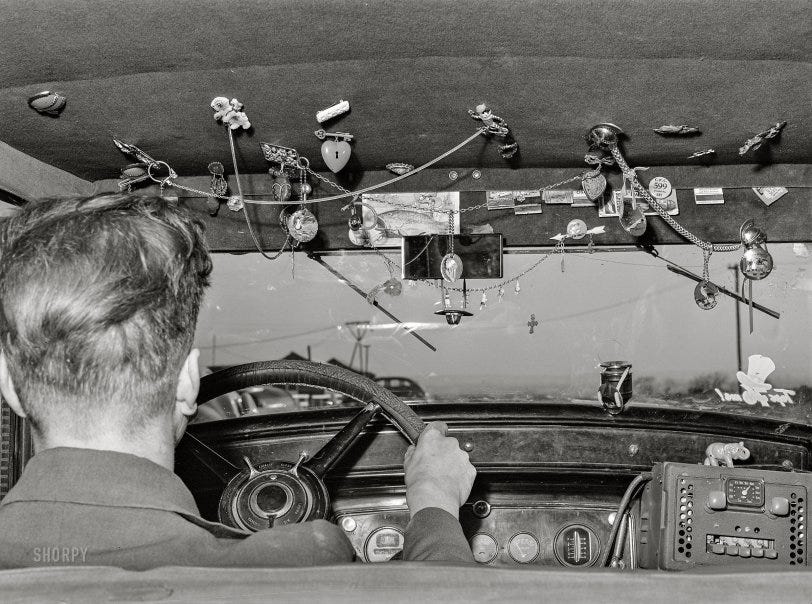
There is a spirit guarding my junk drawer. I swear I’ve seen it, nestled among the button cell batteries, the screwdriver kit, the purple paper clips I have saved from the fourth grade. A flash of tail curled around a ballpoint pen, a tiny red eye staring from the dark recesses of a crumpled hardware store receipt. My spare change keeps disappearing. I leave quarters out for it—little treasures for the guardian of the junk drawer. Sometimes it leaves things out for me, too. A keychain from a family trip to Colorado, ten years ago. A heart-shaped rock, on a cloudy day. The spirit guards more than just drawers.
This is what I like to imagine when I find an item I haven’t thought about in forever, when I discover a little pile of objects that long ago used to mean something to me, and now sit forgotten in a cupboard somewhere. I wish them to be of use to someone—a little guardian spirit, perhaps.
I have been cleaning out my room, which some have called an extra large junk drawer—I choose to rise above such accusations. I have been cleaning out my room, which means I am the household guardian of messy bedrooms. I will admit I was living amidst dunes of unpacked stuff (a vague word) for a few weeks. Indeed, the process of sorting through everything got me thinking about junk.
What a nebulous term. What is it? Don’t things come to us for a purpose? Why do some items make their way into our homes and lay unused in the dusty corners of our lives, forever?
Minimalism has been in style for the past few years, but I just can’t help it—I seem to acquire stuff like no other. I fall in love with rocks and seashells and little plastic sharks sitting on the shelves of aquarium gift shops. I keep my receipts and my tags and every single letter ever sent to me. Recently, I’ve started a junk notebook, in which I’ve taped every scrap of paper I come into contact with. Then, when I’m walking past my bookshelf and my gaze randomly falls onto the small leather book, I get to pull it off the shelf and reminisce.
When I pull open the junk drawer, I get to reminisce as well. Every lost-looking item tells a story. Oh, the set of nails from last winter, when you decided to get into DIYs. The box cutter that belonged to your dad but now has made its way into your house (junk can be inherited, for better or for worse). The broken watch your best friend gave you that you keep forgetting to take to the repairman. What a striking snapshot of our lives in these dusty drawers.
As I was cleaning out my room, I found a strange sort of comfort in stepping between the piles of objects I’d built up on the floor, like I was navigating a labyrinth made up of all of my past lives. I wanted to live among my belongings like a dragon protecting its hoard, wrap my tail around my collection of chipped porcelain mugs. My junk became an architecture.
Studio Ghibli films, I have found, are particularly apt at representing this architecture. In Howl’s Moving Castle, Howl sleeps among his shiny possessions. In The Secret World of Arrietty, the tiny borrowers quite literally live inside stuff—lost, discarded, or “borrowed” human items. There is something comforting about these spaces, with their infinity of possibilities, with their treasures hidden among the architecture of mess. Perhaps it is simply comforting to know that even lost items can find their place, can have somewhere to belong.
Of course, movies paint an idealized picture. The average American household contains a whopping 300,000 individual items, from the simple paperclip to the sofa in your living room that leaves scratch marks on the floorboards. It would be remiss not to touch upon the concept of overconsumption, that uniquely Western ideal that gnaws at our sanity, and our wallets. Perhaps junk drawers have evolved from the fact that we simply buy too much stuff. There was a thought that came back to me over and over when I was cleaning out my room, a stern little voice that told me you’re never buying anything ever again. But our culture leads us to accumulate stuff. And this stuff, regardless of the evils of capitalism, tells a story.
Junk drawers seem to represent the archeology of our lives. The layers build up as we continue to navigate our lives, bringing back items into our dens, storing them where they fit. The sediment settles—dry and cracked Silly Bandz from elementary school at the bottom, the receipt from yesterday’s coffee crumpled near the top.
More than this, junk drawers have… personality? The junk drawer can be very revealing. I have been thinking about this lately: it’s been hard to pin down exactly where my interests lie, what these tell me about who I am. My junk drawer reveals this in no uncertain terms—spools of string from my embroidery phase, old tickets to the theater, tags to the F1 merch I refused to throw out. Oh, I realize, these are the things I love, the causes I support, the people I care about.
Yesterday, I found a polaroid taken when I was still in high school—in it, a friend and I grin up at the camera, arms thrown around each other. I haven’t spoken to them in years. But when I found that picture, its colors still vibrant from where it was hidden away between the pages of a book, it was like I was seventeen again, just home from dinner with my friends, back in time for homework, still glowing with joy.
Maybe the guardian of the junk drawer is real, after all.
Some poem fragments from the junk drawer (my brain):
You hold your book in your hands,
your heart in your chest,
mysterious and human.
[...]
Love, loss, little things.
Cups of tea and tiled roofs.
Laughter. Rivers
[...]
For you, my friends,
wooden shutters, berries, apricot pits,
all the time in the world.
[...]
On winter mornings, when the light is still difficult
and stained at the edges, I think about them all.
The child missing two towns away, the cats
at the bottom of the river, the cherry stands
on the side of the road, the old woman
found alone in her apartment, her son’s letters
tucked neatly under her pillow, the crawling mass
of humanity, I think about them all.
When you lose faith in life and its acuteness
of grief, when you feel more walking massacre
than wounded animal, then you hold out your arms
anyway, then you take it in your hands like a child,
or an injured bird, then despite the bodies,
the world sings.
Some miscellanea from the junk drawer (my internet bookmarks):
Curiosity Clouds by Katie Rose Johnston @ Studio Manifesto
“Inventory—To 100th Street” by Frank Lima
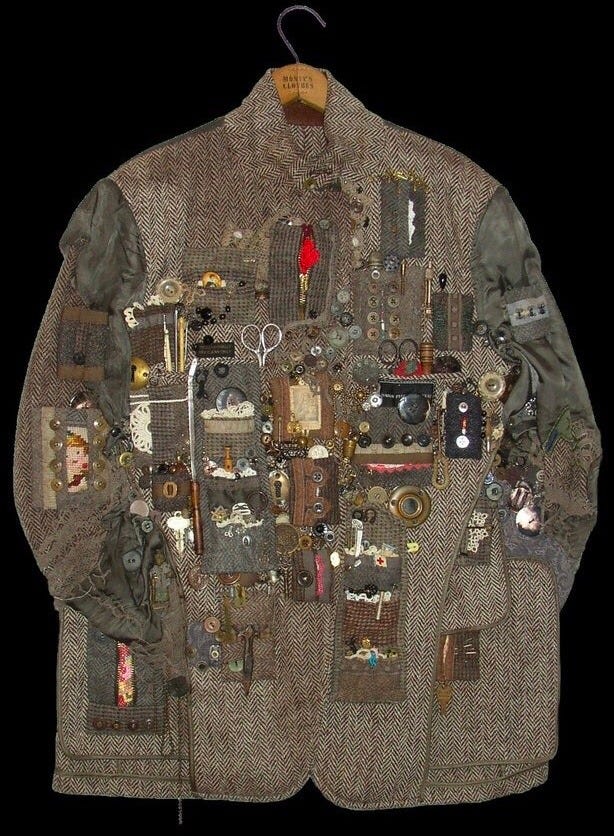
“(Treasure) Hunting Jacket” by Diane Savona
Thanks for reading. Endless love. Eat a Peach!