
On Fish
A love letter to Osteichthyes

After Elizabeth Bishop
I caught a fish and held it out of water over a pink plastic beach pail. It was spring, and it was raining, into the bucket where the fish rested, exhausted, its black eyes. One of its crepe fins was ripped, from a past battle, perhaps, trailing through the water like a torn sail. Its mouth was bleeding, this small, brown thing. I couldn’t understand it, its pain become the brightest part of it. It moved its head slowly in the water, where I tried to keep its gills submerged. Its white mouth was like a galaxy. I don’t know if fish feel pain. I don’t know about their irreconcilable hatred of air. I don’t know a lot of things. The fish slipped like oil back into the river.
Fish are to me, I think, what the Roman empire is to men.1
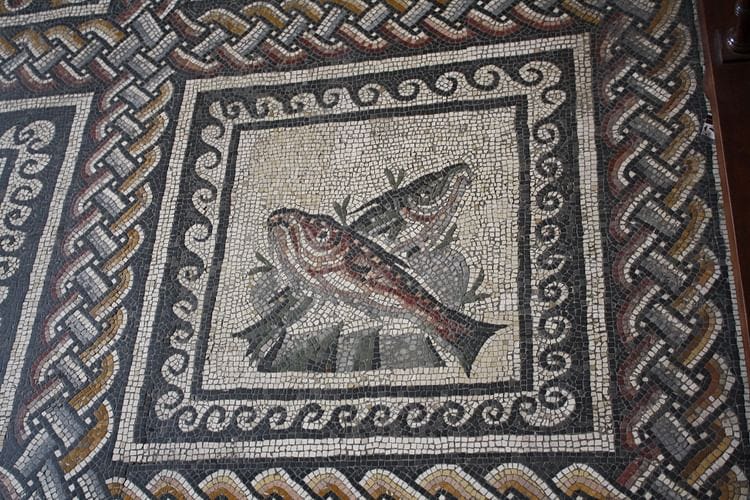
Here is Rome, fallen fifteen hundred years ago, with its aqueducts, coliseums, and only mildly questionable philosophy—I remain unconvinced by stoicism, with apologies to Marcus Aurelius. There is something magical about being able to catch a glimpse of human life thousands of years ago. In 2020, part of the mosaic floor of an 1,800-year-old Roman villa was discovered under the tilled soil of an Italian vineyard.2 In a thousand years, your living room floor could be someone’s farmland. Discoveries such as these remind us that our own lives—our cities, our houses, our living rooms—will one day be ancient.
The infinite circle of time.
Here is the bony fish, hundreds of millions of years old, a reminder of the passing of time, the power of water, the tenacity of life. One difference—the fish is still around. Likely, it always will be,3 at least until the Sun goes out, and then, well, who will be there to bear witness to what used to be a superclass of marine vertebrates? The oldest bony fish fossil ever discovered was determined to be about 480 millions of years old, a near unimaginable timespan. For the archeologist, I imagine finding a fossilized fish between two sheets of sedimentary rock feels akin to discovering an ancient Roman mosaic. Endless wonder, at how much life on Earth has changed. At how little it has.
The infinite circle of time.
This is to say: I have been thinking about fish lately. Something about this animal just… gets to me. I can’t take my eyes off them, their mesmerizing, elegant movements in the water, their unmoving, cartoonish eyes. They are very important to me—I even have a fish tattoo. Please allow me, in this lovely October, to tell you a little more about why.
Fish are ancient, literally. The orange roughy, an unassuming-looking flash of color, can live more than 100 years. The Greenland shark, a less unassuming beast, has the longest lifespan of any known vertebrate. But their age is not the only marvel fish hold. They exhibit stunning social behavior: often compared to flocks of birds, fish schools have actually found to be remarkably more stable,4 likely due to local interactions among individuals in the group. They are social. Ask any fish owner and they will tell you their fish has personality. Fish are unique animals with remarkable capacity for cognition that is often swept under the rug due to their lack of limbs. Yes, I am anthropomorphizing. Try to stop me!
Anthropomorphization aside, fish hold entire ecosystems together. Beware, ye who look down upon the little menhaden, for ye undermine the bottom of a sprawling marine food web. This is not to ignore the actual backbone of said web—primary producers such as plankton and algae—but rather to shine light upon the reliance of your favorite aquatic animals on the tiny game fish of the epipelagic zone. Not to forget, fish also support us. Many communities are reliant upon fishing as a primary source of income and industry. In the 1920s and 1930s, Monterey, California, was a thriving sardine town. The canneries brought glory to this community. Fish come to represent communities—the sardine was Monterey’s identity, until overfishing and greed5 led to the collapse of the fishing and canning industry in the area.
The next time you go to the aquarium, take a second to pause by the small, forgotten tanks in the dim corners of the building. Take a moment to appreciate the guppies, the goldfish, the anchovies and mackerels, the gobies and the humble smelt. Close your eyes and imagine the web that connects you to the sardine and to the entire natural world. Such joy to be found in discovering our place in the family of things.6
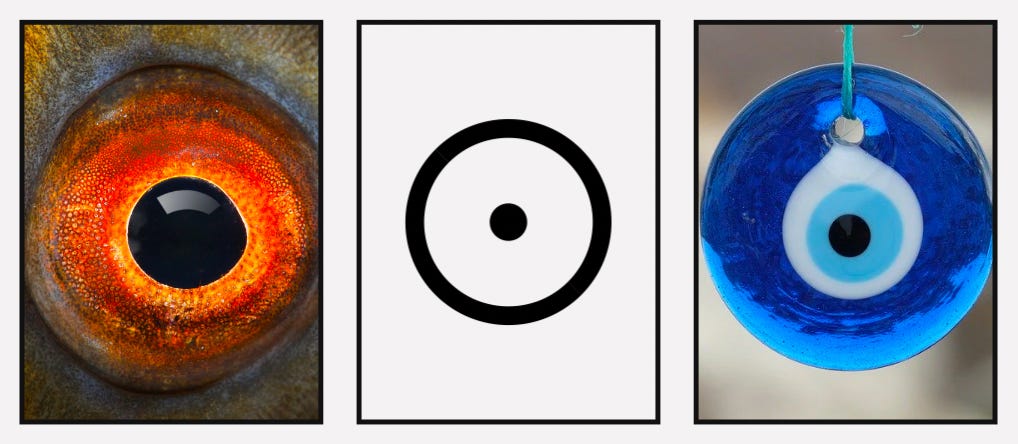
The Fish is brimming with symbolism. Imagine a fish. How would you draw its eye? The eye of the fish is one of the simplest representations of the animal eye that can be found—a circle within a circle, with very little variation. This circle within a circle is so enduring that it has become its own glyph, literally called a fisheye in computing. The fish becomes its eye, the eye becomes a symbol, the symbol comes to mean protection—see the nazar and its protective properties. Coincidentally (or not), the circle within a circle is also the astronomical symbol for the Sun. How delightful to make your way down to the beach in the afternoon and discover the sun in the eyes of a fish. The milky way in a school of sardines!
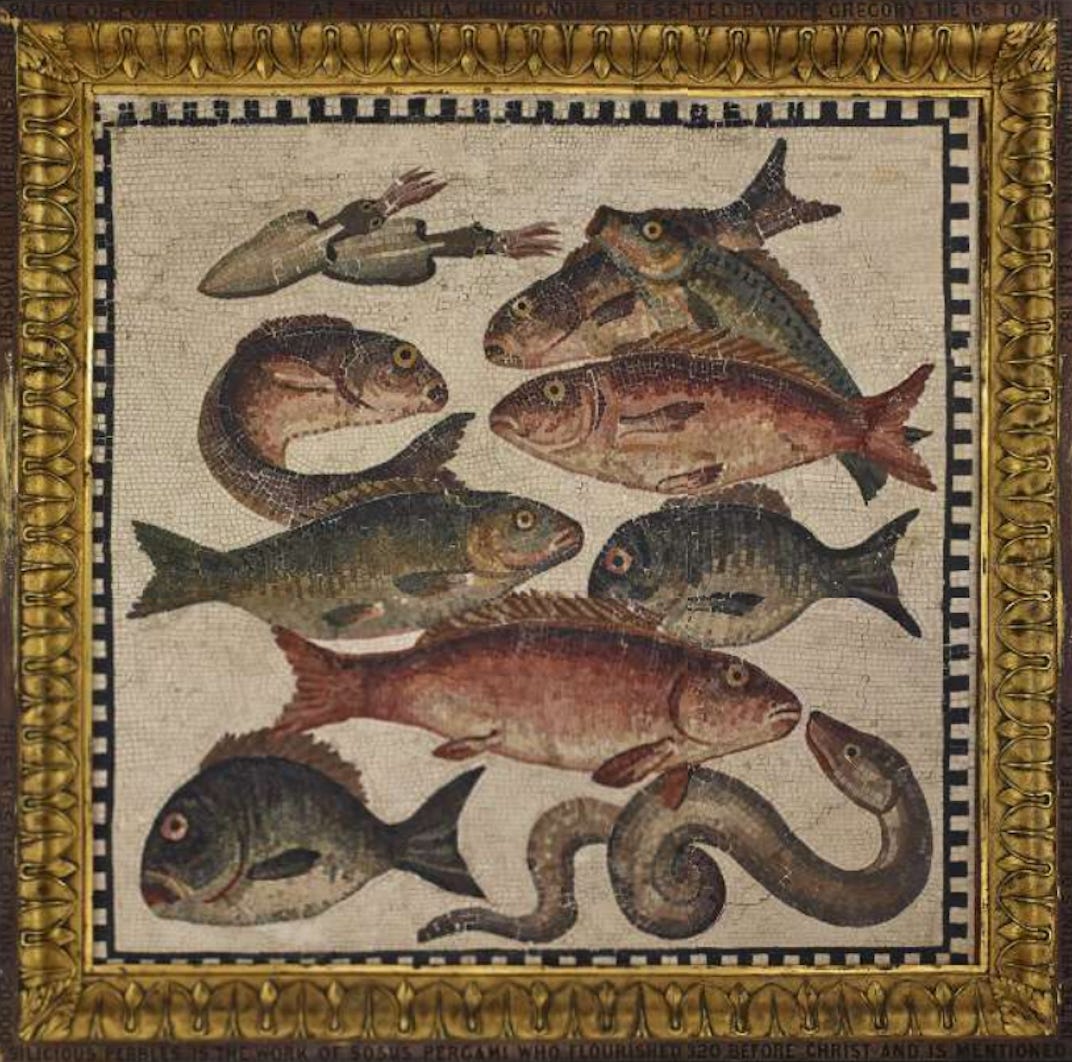
Finally, I offer you this point: fish are very pretty. Fish are gorgeous little silver spoons darting through sun-lit water. The ancient Romans must have agreed, if the popularity of fish in mosaics has anything to do with it. When water is swept over mosaic floors to clean, the tiles gleam with the remains of water, making the naturally reflective fish a perfect representative subject. There is something about these animals that we find beautifully alien. Their limbless, shiny bodies, their disproportionate eyes, their irreconcilable hatred of air—as Elizabeth Bishop’s terrible oxygen suggests (see miscellanea). Rome left us tiled representations of these animals, likely as symbols of affluence, but also, just as likely, as proof of our enduring fascination with the Fish, and while I don’t think about the Roman empire quite as often as I would like, I find a child-like sort of wonder in thinking about how an artisan, thousands of years ago, looked a fish in the eye and found it strange and funny and beautiful, worthy of representation.
Take the piece below, for example. Thirteen mosaic suns!
Today’s theme is fish, so here’s a fish-themed miscellanea. Am I driving this theme into the ground? Don’t answer that.
“The Fish,” by Elizabeth Bishop. Obviously.
Fish recorded singing dawn chorus on reefs just like birds, in case you needed more fish/bird parallels.
Steal Smoked Fish, by the Mountain Goats.
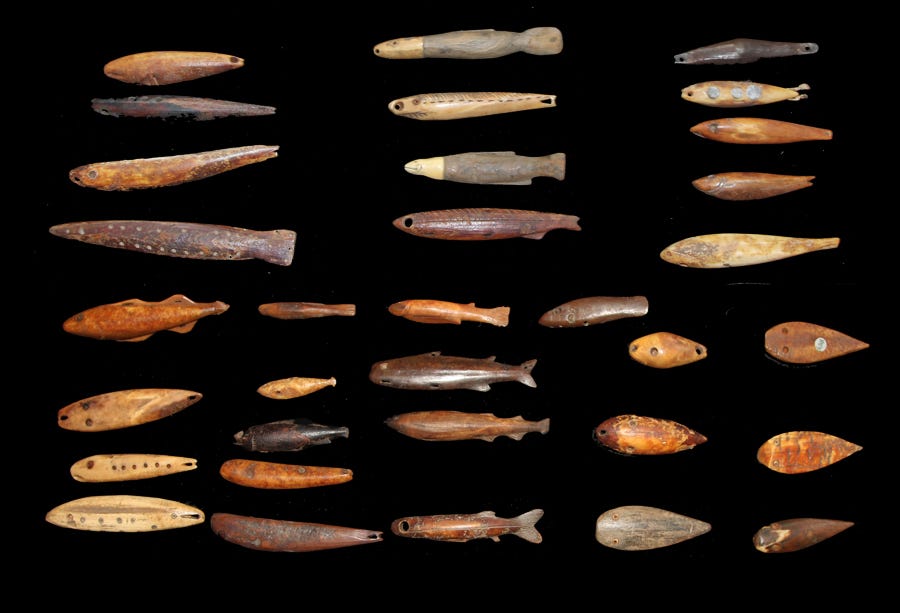
These ivory fish weights from the Bering sea.
Thanks for reading. Endless love. Eat a Peach!
“How Often Do You Think about the Roman Empire?” Know Your Meme, 14 Sept. 2023, knowyourmeme.com/memes/how-often-do-you-think-about-the-roman-empire.
Long-term effects of climate change pending…
Hemelrijk, Charlotte K., and Hanno Hildenbrandt. “Schools of Fish and Flocks of Birds: Their Shape and Internal Structure by Self-Organization.” Interface Focus, vol. 2, no. 6, 22 Aug. 2012, pp. 726–737, https://doi.org/10.1098/rsfs.2012.0025
I am oversimplifying a little. I encourage you to read into the history of the Monterey canneries, if you’re interested!
“Wild Geese,” by Mary Oliver.